Do you need a license for an electric dirt bike? Where you ride decides
 By Iris Bake · Updated
It depends on where the wheels touch. On private land, none of the 10 states below asks for a driver's license. On public trails and OHV areas, most of them want a sticker, permit or registration instead, though Illinois (for riders 16 and up) and Ohio also want a driver's license. On public roads you need a motorcycle license and a plate, and many electric dirt bikes are sold for off-road use only, so they can't get one. A bike inside the e-bike limits (working pedals, 750 W, motor help ending at 20 mph) follows bicycle rules instead.
Where a license is needed, and where it isn't
Do you need a license for an electric dirt bike? The answer changes with the ground under you, not with the bike alone. State law splits riding into three places, and each one has its own paperwork.
- Private land. Your own property, or someone else's with their permission. Driver's license rules cover public roads and, in a few states, public land. None of the 10 states we read asks for one here. Michigan is the outlier on age: riders under 16 need an ORV safety course even on private land.
- Public trails and OHV areas. State forests, OHV parks, motorcycle trails. Here the usual ask is a sticker, a permit, a title or a registration, not a license. Two exceptions: Illinois DNR sites want a valid driver's license from riders 16 and older, and Ohio requires one on any public land.
- Public roads. A motorcycle license (Class M or an M endorsement), registration, a plate and insurance. The catch is the bike: one built for off-highway use usually can't be registered for the road at all.
The fourth case is the e-bike. A bike that fits your state's electric bicycle definition rides under bicycle rules on most paths and streets, with no motorcycle license. Most electric dirt bikes don't fit it, and the next section shows why.
Why most electric dirt bikes aren't e-bikes in the eyes of the law
Most of the 10 states draw the e-bike line in the same three places: working pedals, a motor rated at 750 watts or less, and motor help that cuts out at 20 mph on a Class 1 or 2 bike (28 mph for Class 3 where the state has it). The federal consumer-product definition in 15 U.S.C. 2085 uses the same shape: operable pedals, under 750 W, under 20 mph on the motor alone. Cross any of those lines and the bike becomes a motorcycle, a moped or an off-highway vehicle, depending on the state.
Here is how real bikes land against those lines, using the makers' own numbers:
- The Sur-Ron Light Bee X lists 10,000 W peak and 50 mph. That's far past 750 W and 20 mph, so it's a motorcycle in every definition we read. Creature Racing, one of its US dealers, labels every e-moto it sells off-road only. The Sur-Ron question has its own page: is a Sur-Ron street legal.
- The Segway Xyber lists 6,000 W peak and 43 mph. Segway's store page says plainly it is "not an on-road ebike" and recommends it for riders 18 and older (Segway Xyber review).
- The Riding'times GT73 Pro Safety Edition has pedals, a 750 W motor and a factory cap of 15 mph. On paper that sits inside the limits, but Riding'times itself notes that Class 2 status also hangs on how the throttle works, the labels, the equipment and the rules of your state and town.
- The STACYC 20hDRIVE carries STACYC's own Class 2 label: a 500 W brushless hub motor, pedal assist and a twist throttle up to 20 mph, per STACYC's product page. STACYC asks owners to follow their local e-bike rules.
- The ZONVEER ZX3 carries a "Class-2 Road Legal" badge and a 20 mph Commute Mode, yet ZONVEER lists a 2,000 W nominal motor. Every definition in the table below stops at 750 W, so a badge alone isn't proof. Read the motor rating against your state's text.
Watch the small wording gaps between states, too. Pennsylvania caps an electric pedalcycle at 100 lb and wants riders 16 or older. New York keeps Class 3 to cities with at least a million residents and caps it at 25 mph. Georgia's 2024 code text sets the 750 W limit but names no speed at all.
Public trails and OHV areas: stickers, permits and registration
Off-road on public land, states care less about who you are and more about whether the bike is on their books. What they ask for varies a lot:
- California wants a Green Sticker from the DMV, renewed every two years. Since January 1, 2026 (SB 586), electric off-highway motorcycles need one just like gas bikes, and the state OHMVR FAQ says no driver's license is required off-highway.
- Texas sells a $16 OHV decal through Texas Parks and Wildlife, good from September 1 to August 31. TxDMV doesn't register off-road motorcycles, though its manual says they should be titled.
- Florida requires a title for an off-highway motorcycle ridden on public land. You get a title validation sticker, not a plate or a registration decal.
- New York treats dirt bikes as ATVs: DMV registration at $12.50 a year plus a $12.50 plate fee, and liability insurance. State lands are closed to them except areas posted as open.
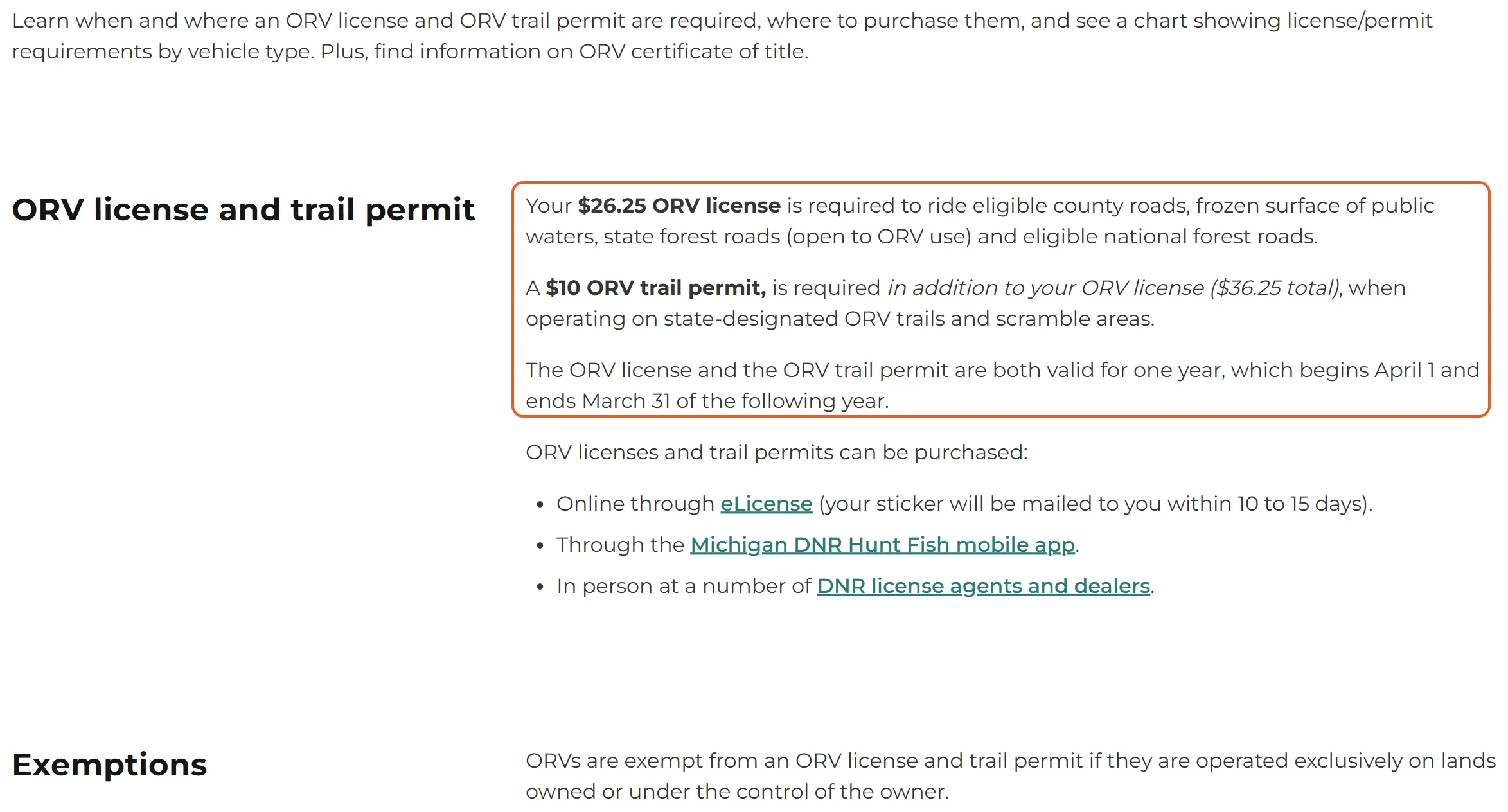
- Michigan wants two stickers on state trails, the ORV license ($26.25) and the trail permit ($10), both running April 1 to March 31, and a title from the Secretary of State.
- Ohio requires BMV registration unless the bike is ridden only on the owner's land.
Some public land is simply closed. Georgia State Parks don't allow off-road vehicles. North Carolina's Wildlife Commission keeps off-road vehicles, ATVs and e-bikes off its game lands, apart from designated National Forest areas. Pennsylvania's state-forest ATV trails don't take trail bikes. DCNR points riders to two motorcycle trails in Bald Eagle State Forest.
Public roads: a motorcycle license, and the plate problem
On a public road, an electric dirt bike that isn't an e-bike counts as a motorcycle. The rider needs the motorcycle class on their license (Pennsylvania calls it Class M, and North Carolina wants a motorcycle endorsement or a learner permit), plus registration, a plate and insurance. Ohio's code is blunt: a driver's license or motorcycle endorsement on any street or highway.
The license is the easy part. Getting a plate for a bike sold for off-road use usually isn't possible. California's OHV bulletin, citing the DMV, says a motorcycle built for off-highway use can't be made road-legal later unless it left the factory as a dual-purpose bike. A bike without the federal safety (FMVSS) labels on its frame is read as off-highway. In California, riding one on the highway can be cited as an unregistered vehicle and as operating a motorcycle without the right license class. Florida's FLHSMV procedure RS-61 leaves off-road-labeled dirt bikes unregistered, and New York won't register ATV-class dirt bikes for streets unless a road is posted for ATV use.
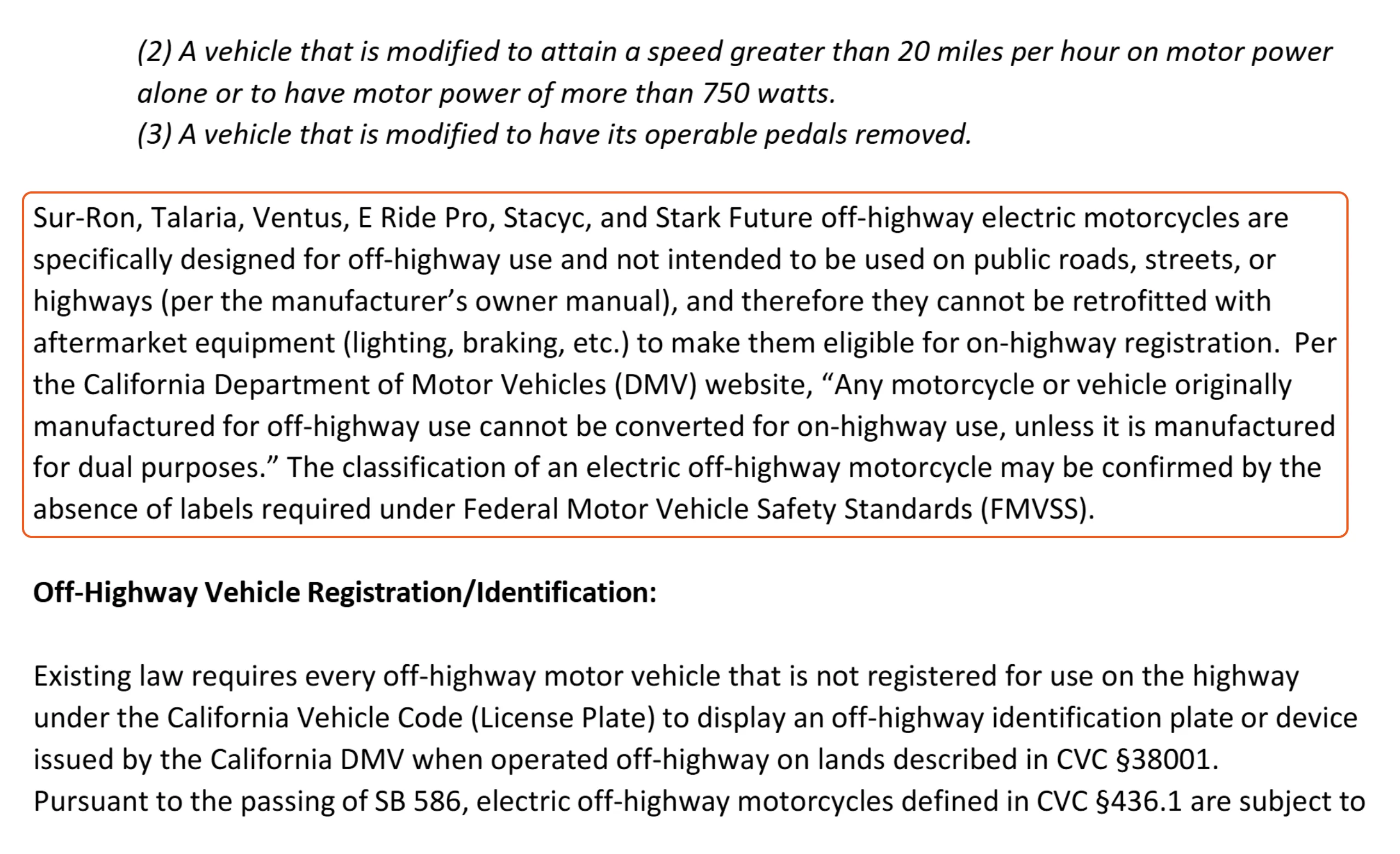
A few electric bikes are built for the road from the factory. Stark states the VARG EX ($13,040) meets US road homologation, and the bike comes with a Manufacturer's Statement of Origin (MSO) to register it. You'd register and ride it like any motorcycle, on a motorcycle license. California is the exception to watch: the same OHV bulletin names Stark Future among the off-highway brands that can't be converted, so a California buyer should confirm the EX's road paperwork with the DMV first. Bolting lights and mirrors onto an off-road bike is a different story. The street-legal electric dirt bikes page covers which models can get a plate and how.
State by state: 10 states, read on official pages
Do you need a license for an electric dirt bike in your state? The table covers the 10 most populous states. Every row links to the DMV page, park agency page or statute text it came from, with the date we read it. Laws change. If your state isn't here, its DMV and state parks pages are the place to check.
| State | Public trails and OHV areas | Public roads | What counts as an e-bike |
|---|---|---|---|
| CaliforniaOHV Bulletin 25-1 · CHP e-bike bulletin · OHMVR FAQ, Nov 20, 2026 | Green Sticker from the DMV, renewed every two years; electric off-highway motorcycles need one since January 1, 2026 (SB 586). No driver's license needed off-highway. | Not possible: a bike built for off-highway use can't be converted for road registration. Riding it on a highway can be cited as an unregistered vehicle and an unlicensed motorcycle operator. | 750 W or less with working pedals; Class 1 and 2 assist to 20 mph, Class 3 to 28 mph. No license, registration or plate. |
| TexasTPWD decal page · TxDMV registration manual, Nov 20, 2026 | $16 OHV decal from Texas Parks and Wildlife (September 1 to August 31) to ride public OHV land. Off-road motorcycles aren't registered but should be titled. | TxDMV doesn't register off-road motorcycles built only for off-highway use, so there's no plate for the road. | Under 750 W, working pedals, assisted top speed 28 mph or less. |
| FloridaFla. Stat. 317.0006 · FLHSMV RS-61 · Fla. Stat. 316.20655, Nov 20, 2026 | A title is required for an off-highway motorcycle ridden on public land. No plate or registration decal; a title validation sticker instead. | Dirt bikes noted for off-road use are not registered (FLHSMV). Any road motorcycle needs a license that authorizes it. | Under 750 W with working pedals; Class 1 and 2 to 20 mph, Class 3 to 28 mph. Exempt from license, registration and title laws. |
| New YorkNY DMV: register an ATV · NY DMV: unregistered vehicles · NY VTL 102-c, Nov 20, 2026 | Dirt bikes count as ATVs: DMV registration ($12.50 a year plus a $12.50 plate fee) and liability insurance, no driver's license. State lands are closed to them except posted areas. | Can't be registered or ridden on streets or highways, unless a road is posted for ATV use. | Under 750 W with working pedals; Class 1 and 2 to 20 mph, Class 3 (25 mph) only in cities of 1 million or more. |
| PennsylvaniaPennDOT fact sheet · 75 Pa.C.S. 7701 · DCNR ATV riding, Nov 20, 2026 | Trail bikes are outside the ATV law, and ATV trails in state forests are closed to them. DCNR runs two motorcycle trails in Bald Eagle State Forest. | A road motorcycle needs a Class M license, a motorcycle plate and a safety inspection (PennDOT). | 750 W or less, working pedals, 20 mph on the motor, 100 lb or less. No license, but the rider must be 16 or older. |
| Illinois17 Ill. Adm. Code 135 · 625 ILCS 5/11-1426.1 · 625 ILCS 5/1-140.10, Nov 20, 2026 | DNR OHV sites sell a usage permit ($20 a day, $65 for four days). Riders 16 and older need a valid driver's license there. | Off-highway motorcycles are banned on streets and highways, except where a local ordinance allows them on roads of 35 mph or less, with a driver's license. | Under 750 W with working pedals; Class 1 and 2 to 20 mph, Class 3 to 28 mph. |
| OhioORC 4519.02 · ORC 4519.44 · ORC 4511.01, Nov 20, 2026 | Off-highway motorcycles must be registered with the BMV, and a driver's license is required on any public land. Under 16 only with a licensed adult 18 or older. | A driver's license or motorcycle endorsement is required on any street or highway; state highways are off-limits to off-highway motorcycles. | Under 750 W with working pedals; Class 1 and 2 to 20 mph, Class 3 to 28 mph. The code treats it as a bicycle. |
| GeorgiaGeorgia DOR: exempt vehicles · Georgia DOR: MPOHV · Georgia State Parks FAQ, Nov 20, 2026 | No state registration or title for off-road vehicles. State parks don't allow them. | Dirt bikes are excluded from Georgia's road registration for multipurpose off-highway vehicles. | 750 W or less with working pedals; not a motor vehicle under the code. |
| North CarolinaNCDMV vehicle types · N.C.G.S. 20-4.01 · NCWRC game lands FAQ, Nov 20, 2026 | Off-road vehicles, ATVs and e-bikes are not allowed on Wildlife Commission game lands, except designated National Forest areas. | A road motorcycle is titled and registered like a car, and the rider needs a motorcycle endorsement or learner permit. | 750 W or less with working pedals, 20 mph or less on the motor alone. |
| MichiganMichigan DNR permits · Michigan DNR age rules · MCL 257.13e, Nov 20, 2026 | $26.25 ORV license plus a $10 trail permit on state trails (April 1 to March 31) and a title from the Secretary of State. Riders under 16 need an ORV safety course. | A street-licensed off-road motorcycle still needs both stickers on state trails. No M or US highways except designated connectors. | 750 W or less with working pedals; Class 1 and 2 to 20 mph, Class 3 to 28 mph. |
Kids, teens and age limits
Most of these states set age rules for the bike or the place, not a license for the child. California has no minimum age for off-highway motorcycles, only the rule that the rider must reach and work every control, and its FAQ says a helmet isn't required by law off-highway, though it's highly recommended. Other states go further:
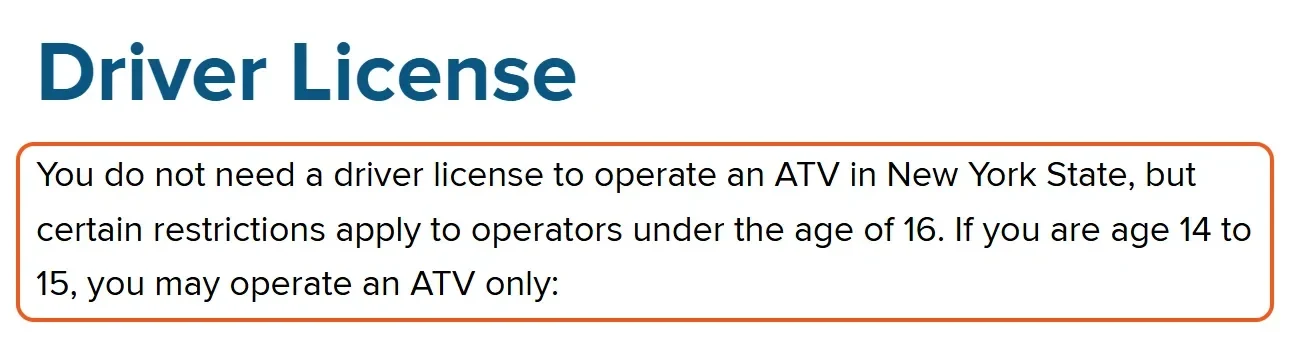
- New York (dirt bikes count as ATVs): a rider younger than 14 needs an adult along, unless the family owns or rents the land. At 14 and 15, riding alone on land open to ATVs needs a DMV-approved safety course.
- Ohio: under 16 off private property only with a licensed adult 18 or older.
- Michigan: under 16 must pass an ORV safety course, on public or private land.
- Illinois: riders 16 and older on DNR OHV sites need a valid driver's license.
- Pennsylvania: riders of an electric pedalcycle must be at least 16.
Makers set their own floors as well. Segway recommends the Xyber for 18 and up, Stark lists 16 years as the minimum for the VARG EX, and Riding'times lists 12 years for the GT73 Pro. Two pages sort bikes by age and size: best electric dirt bikes for teens, plus best electric dirt bikes for kids for the youngest riders.
What to check before you buy
Decide where the bike will actually be ridden, then match the bike to that place. Four checks cover most of it:
- Your riding spot. Backyard or a friend's land: little paperwork. State trails: find the sticker, permit or registration your state sells and what it costs. Streets: you need a road-registered motorcycle and the license for it.
- The motor rating and speed cap. If you want e-bike rules, look for working pedals, 750 W or less and assist that stops at 20 mph. A peak rating in the thousands of watts puts the bike in motorcycle territory.
- The paperwork. Florida and Michigan title off-road motorcycles, and Texas says they should be titled. Ask the seller for the MSO and the VIN before you pay, so a title is possible later. A dealer speed cap does not add a VIN either: see how fast the Talaria X3 Pro goes as sold.
- The maker's own label. "Off-road use only" on the store page means no plate. "Street legal" in an ad needs checking against your state's text.
If you've settled where you'll ride, the best electric dirt bikes for adults page compares the bigger bikes, and what an electric dirt bike costs adds price ranges by class.
FAQ
Can a 14-year-old ride an electric dirt bike?
In many places, with conditions attached. In New York a 14-year-old can ride alone on land open to ATVs after a DMV-approved safety course. In Ohio someone under 16 needs a licensed adult along off private property. In Michigan they need an ORV safety course first. No state in our table gives a 14-year-old a motorcycle license for the road.
Do you need insurance for an electric dirt bike?
On public roads, yes, as with any motorcycle. Off-road it depends on the state: New York requires liability insurance for ATV-class dirt bikes, except on the owner's own property. California's CHP bulletin says an e-bike needs no insurance.
Can I put a plate kit on an electric dirt bike and ride it on the street?
Usually not. California's DMV says a vehicle built for off-highway use can't be converted for the highway unless it was made dual-purpose, and Florida won't register a dirt bike labeled for off-road use. A plate kit adds lights and mirrors, but it doesn't change how the state classifies the bike.
Do I need a license to ride on private property?
None of the 10 states we read asks for a driver's license on private land. You still need the owner's permission, and Georgia's code asks for express written permission. Michigan riders under 16 need an ORV safety course even on private land.
Is a Sur-Ron an e-bike?
No. The Light Bee X lists 10,000 W peak and 50 mph, well past the 750 W and 20 mph e-bike lines, so states treat it as a motorcycle or an off-highway vehicle.